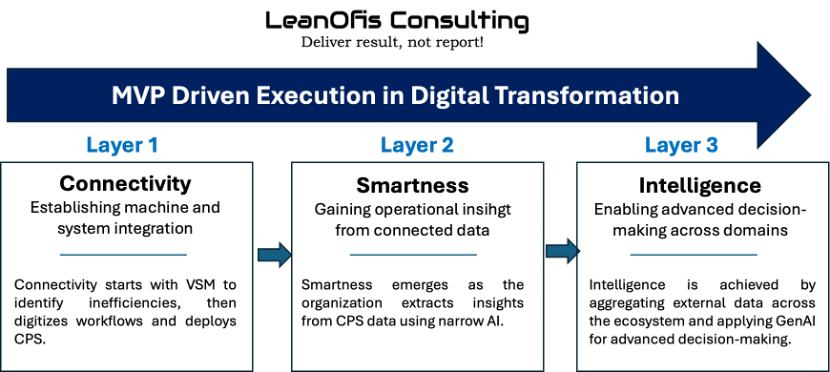
A Minimum Viable Product (MVP) is a simplified version of a product developed to deliver early value with minimal effort while collecting user feedback from real-world conditions (Ries, 2011). Rather than aiming for completeness, the MVP focuses on validating the most critical assumptions underlying a concept. This approach enables teams to test functionality, uncover latent needs, and iteratively refine direction. As feedback is gathered, it influences not only operational tasks but may also reshape roadmaps or strategic objectives. In many cases, it provides the basis for a strategic pivot, moving from assumptions to evidence-based decision-making.
In the context of digital transformation (DT), the MVP takes form as a pilot line—a focused implementation that tests the first iteration of transformation within a limited scope. It typically begins with identifying inefficiencies through Value Stream Mapping (VSM), followed by digitizing workflows and deploying Cyber-Physical Systems (CPS). This stage aims to establish connectivity—integrating machines, systems, and data sources to achieve traceability and real-time visibility. Though it does not yet deliver full intelligence, it lays the essential foundation for digital maturity.
The second phase introduces smartness—the organization’s ability to extract operational insights from its connected systems. This is accomplished through the Accumulate and Learn stages, where structured data collected via CPS is analyzed using narrow AI applications such as predictive maintenance, anomaly detection, and quality forecasting. These use cases are deployed incrementally to solve domain-specific problems, enhancing localized decision-making and supporting early returns on digital investment.
Once internal CPS infrastructure and analytical capabilities are mature, the transformation progresses toward the third phase: intelligence. At this stage, the organization begins to aggregate and contextualize external data from suppliers, customers, and logistics partners—creating a broader digital thread across the ecosystem. The accumulation of cross-organizational data enables the deployment of Generative AI (GenAI) for advanced decision-making tasks, including autonomous scheduling, prescriptive analytics, and generative design. Intelligence here reflects the system’s ability to act adaptively, make informed decisions across domains, and continuously improve itself.
Throughout all three phases, success depends on the careful integration of process design, technological infrastructure, and algorithmic maturity. A stepwise, maturity-based approach is essential: each layer must be consolidated before advancing to the next. This ensures that the digital transformation remains scalable, resilient, and strategically aligned, enabling the shift from data collection to decision autonomy without risking premature complexity.