Transformation Journey

Transformation is a continuous journey, not a destination. In the transformation journey, the first phase is segmentation. Segmentation involves identifying and clarifying customer needs and expectations. Since different customers have varying needs, we can’t serve them all with the same approach. By segmenting customers based on their needs, we can set up dedicated teams for each segment, a process known as value stream management. For example, a company might have two value streams: one for high-end products and another for low-end products. Understanding customer needs through segmentation is crucial as the starting point of the transformation journey.

In phase two of the transformation journey, the focus is on selecting the appropriate production methods for each value stream. To determine which methods to use, we need to conduct Pareto and ABC analyses to identify the best production methods for each SKU in the value stream. There are four main types of production methods: make-to-stock for A-type products, configure-to-order for B-type products, make-to-order for C-type products, and engineer-to-order for products that are not produced frequently. This phase is crucial because it helps ensure that products are produced according to their specific characteristics.

Phase three of the transformation journey involves setting the initial stage for the ValueStream. This stage focuses on identifying the stock positions within the ValueStream for raw materials, work in progress, finished goods, and components. To do this effectively, accurate data is crucial. Traditional forecasting methods are not sufficient, so machine-learning-based forecasting methods like Holt-Winters/Exponential Smoothing, or ARIMA are recommended. By analyzing QR values (quantity and reorder point) for each stock, we can manage stocks in the ValueStreams more effectively. Additionally, we ensure that each material/product is positioned correctly within the ValueStream, whether in the finished goods area or the raw material area. This phase marks the initial setup for the ValueStream.

Phase four of the transformation journey focuses on supporting the initial stages by establishing standards. This involves standardizing every process within the ValueStream using Lean Principles. Lean Principles include implementing just-in-time (JIT), Heijunka, Total Productive Maintenance (TPM), and Jidoka concepts, along with smart applications, to ensure smooth material and information flow. Additionally, there’s a focus on improving the skills of the teams and staff, as skilled workforce is crucial for organizational development. In this phase, companies also aim to reduce waste (Muda) by conducting Kaizen events to streamline processes and reduce lead time. Key elements of Lean Principles such as Value, ValueStream, Flow, Pull, and Perfection must be implemented effectively in the manufacturing environment.

Phase five of the transformation journey involves moving to an Agile level, where companies adopt Agile approaches to position themselves well in the market. Agile supply chain management becomes crucial in this phase, focusing on strategic sourcing, network integration, market sensitivity, and information management. Companies must consider implementing these key pillars into their streams. Additionally, Agile product development, leveraging design thinking, and Agile project management play significant roles in this phase. Overall, integrating Lean, design thinking, and Agile concepts is essential for staying competitive in the market.

The final phase of the transformation journey is digital transformation, which many companies struggle with due to not completing the preceding five phases. Lean and Agile principles serve as the foundation of the transformation, while digitalization acts as the pillars that elevate it. Technology should be implemented on top of Lean and Agile principles. In this phase, the primary aim is to achieve CPS (Cyber-Physical Systems) structure, which involves integrating IT and OT. Companies typically begin by implementing either IT or OT, then proceed to integrate the other. Ultimately, the integration of IT and OT leads to CPS integration, facilitating the integration of digital systems within the overall ecosystem.
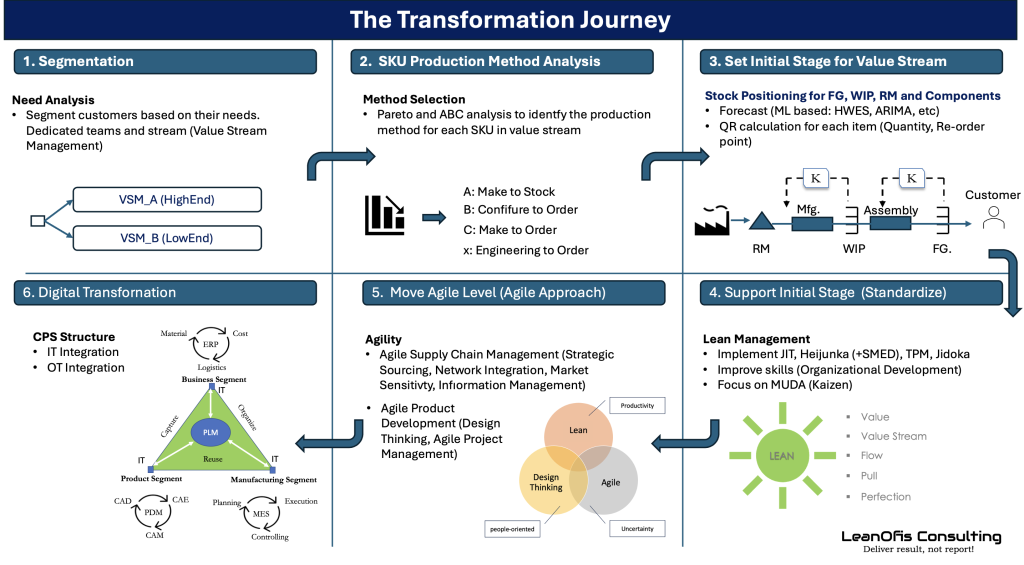
SO, in summary; The transformation journey encompasses six phases, each building upon the other to achieve comprehensive change. Phase one focuses on segmentation, understanding customer needs and expectations, while phase two involves selecting production methods tailored to each segment. Phase three establishes the initial stage for ValueStreams, identifying stock positions and leveraging machine-learning-based forecasting methods. In phase four, standards are established using Lean Principles, with a focus on improving team skills and reducing waste. Phase five shifts to an Agile level, emphasizing Agile supply chain management and Agile product development. Finally, phase six marks the digital transformation phase, where Lean and Agile principles serve as the foundation, and technology is implemented atop them, culminating in CPS integration to integrate digital systems within the overall ecosystem.
Change and Leadership

(Translated from my latest book, ‘Atölyeden Akıllı Fabrikaya’)

In academic debates, an organization is frequently characterized as “a community voluntarily united by a common purpose.”. The keywords here are purpose and voluntarism. Effectively driving change within an organization necessitates a focus on these concepts, posing a fundamental question: How can we instill in our employees a sense of ownership and commitment akin to that of dedicated factory citizens? This inquiry places significant responsibilities on top management, who serve as the leaders of change.

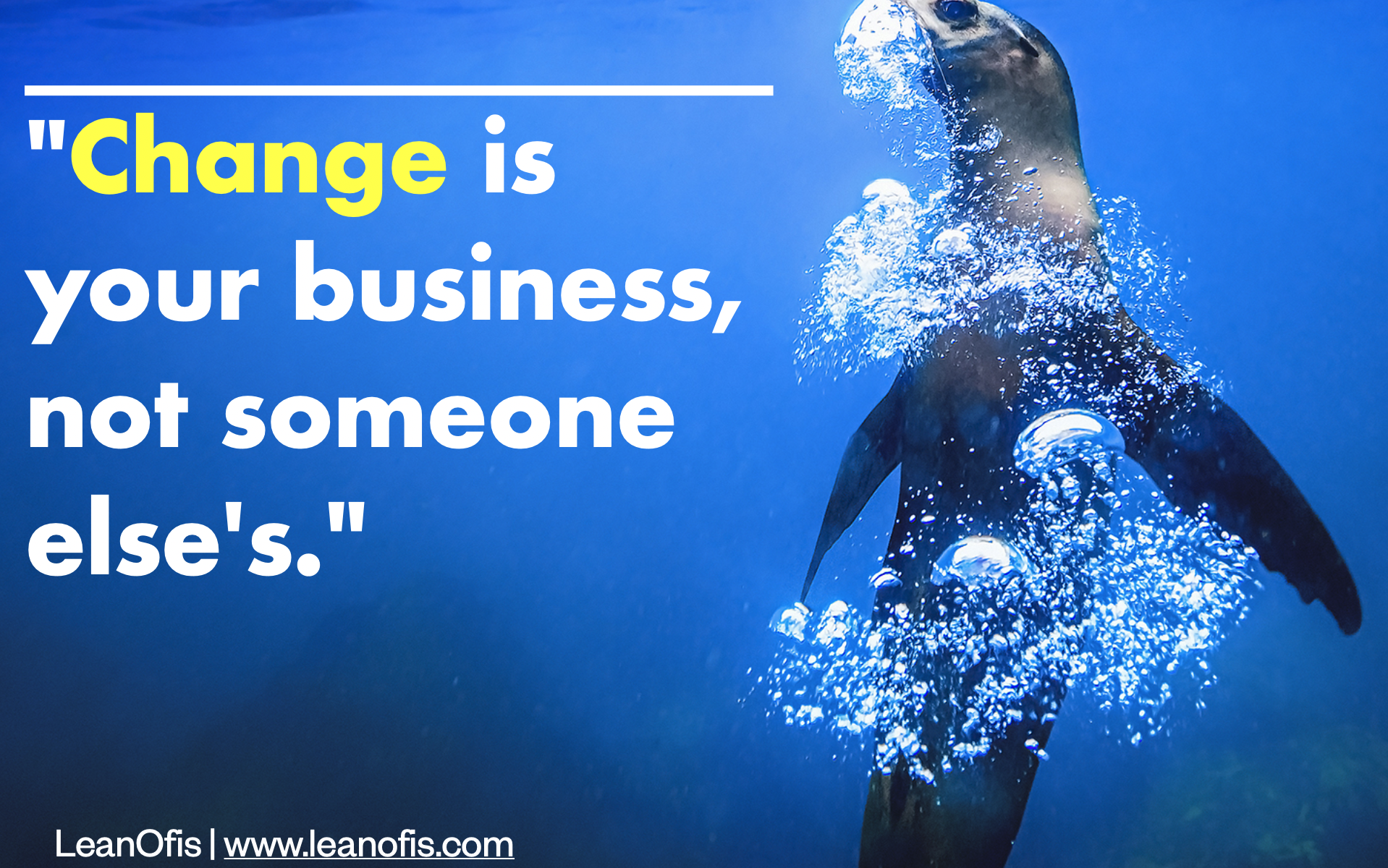
At the heart of change lies a fundamental principle: “Change is your business, not someone else’s.” Change constitutes an internal process aimed at enhancing business operations, individual engagement, and cultural evolution. While external support from consultants or trainers can be valuable, the primary drivers of change should be business managers. Actions carry more weight than mere words, demanding leaders to actively engage in the change process. This entails generating solutions rather than making excuses, proactively nurturing team development, taking decisive action, and immersing oneself in the field, collaborating closely with the team.

Successful leadership hinges on certain principles and traits essential for steering teams and organizations through transformational journeys. These core elements are pivotal in attaining excellence and fostering enduring change within the organizational fabric.

  • Time management is crucial to being an effective and respected leader. Use your time wisely and efficiently, dedicating yourself to at least half a day of work. Whether it’s the first 12 hours or the latter 12 hours, it doesn’t matter. This commitment sets expectations for your team and demonstrates your determination to achieve goals.
  • Interacting with your teams in the field is necessary to build strong relationships and understand the challenges they face. Spend time in the field with your teams, actively participate in problem-solving processes. This hands-on approach shows your support and fosters a sense of camaraderie among team members.
  • Knowledge is power, and being knowledgeable in your field as a leader earns respect from your teams. Stay updated with the latest developments and trends in your industry. By staying informed, you can make informed decisions and offer valuable new insights to your team.
  • Focus on teaching through action. Leading by example, actively demonstrating desired behaviors and work ethics, inspires your team members to do the same. Encourage a learning environment where mistakes are allowed. Mistakes provide valuable opportunities to grow and develop. Strive to be a leader who leaves a lasting impact, like an unforgettable elementary school teacher. Embrace continuous learning, not only for yourself but also for your team. Invest in their growth and development by providing education and mentorship opportunities. When you nurture their potential, you pave the way for a culture of continuous improvement and development within the organization.
  • Allow time for change. In the journey of change, one of the key aspects to grasp is the importance of allowing time for the transformational impact to emerge. Change is not a sudden, isolated event; rather, it arises from the collective impact of various movements, much like the gradual turning of a watermill wheel. Just as each rotation of the wheel contributes to the mill’s progress, every step taken in the change process represents an opportunity for learning, adaptation, and growth. Embracing this gradual evolution concept is necessary to promote meaningful and sustainable change. While we may crave instant results and immediate transformations, real change requires a deep understanding that patience, perseverance, and the journey itself are transformative. Each turn of the wheel symbolizes progress, development, and the chance to refine our approach. Change is not limited to reaching a singular, miraculous moment; rather, it is an ongoing journey of improvement and enhancement. This process provides valuable opportunities to learn from our experiences, adapt our strategies, and grow both personally and professionally.
  • Involving team members in the decision-making process is a powerful way to foster a culture of collaboration and empowerment. When employees have a say in decisions that affect their work, they feel valued and motivated to contribute their best ideas and efforts. Decision-making based on consensus allows for diverse perspectives and addresses potential blind spots. Implementing decisions quickly, considering the team’s input, is crucial for maintaining momentum and seizing opportunities without unnecessary delays.
  • Setting clear and well-defined goals is another critical aspect of effective leadership. Putting goals in writing not only provides clarity but also serves as a source of motivation and accountability. When goals are written down, they become tangible commitments that guide the team’s actions and efforts. Plans may change as circumstances evolve, but written goals serve as a constant reference point, ensuring alignment with the team’s inclusive vision.
  • The essence of leadership lies in humility. A good manager or leader does not seek to showcase their greatness but inspires others to greatness. By remaining humble, leaders create an atmosphere of trust, respect, and camaraderie. Treating others with kindness and thoughtfulness, regardless of their position, encourages a culture of collaboration and empowerment. Ultimately, a leader’s true value is reflected not in their self-proclaimed accomplishments but in the impact they have on their teams and the organization they serve.