
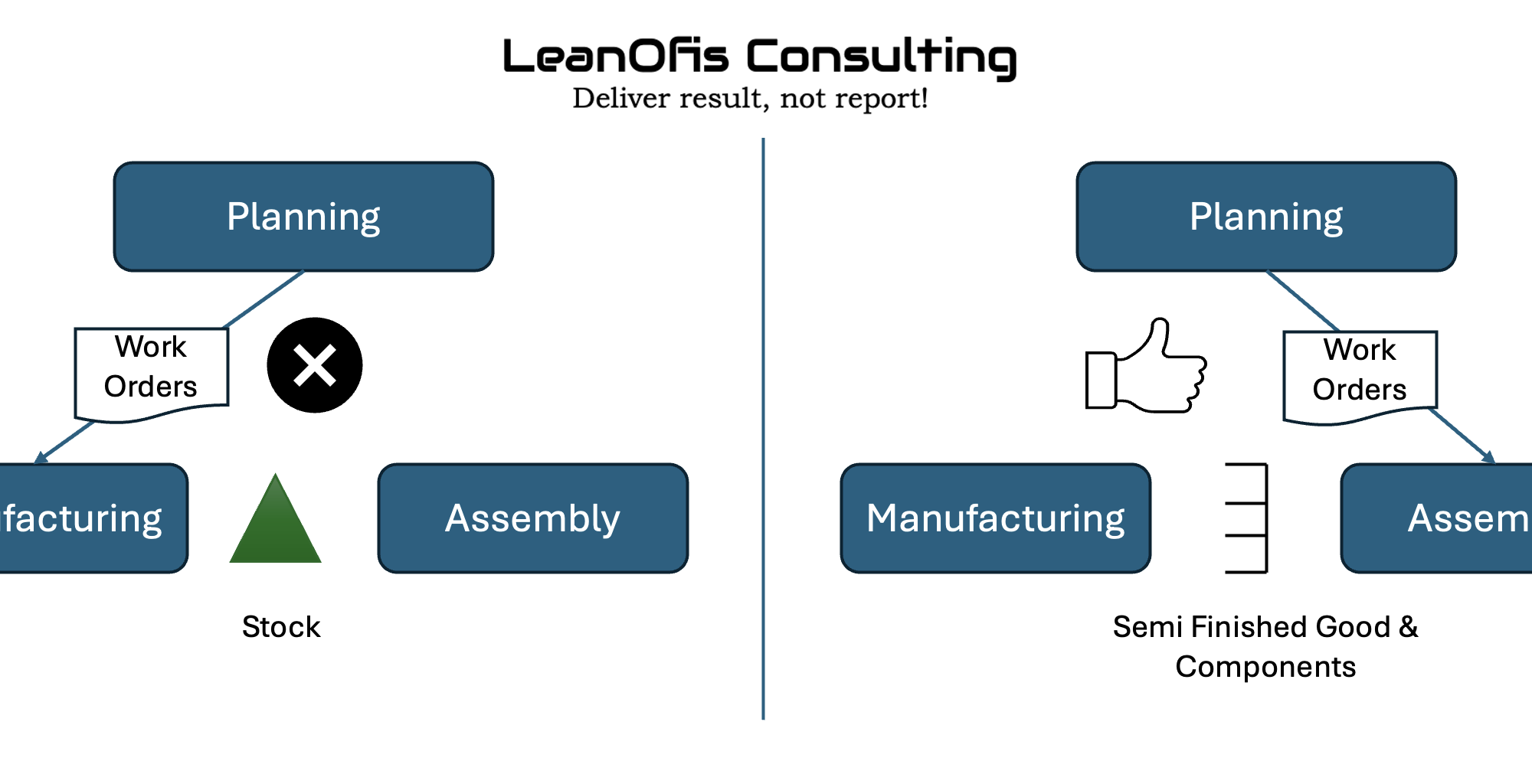
Production primarily consists of two main functions: machining (manufacturing) and assembly. Machining involves transforming raw materials into parts or semi-finished products, while the assembly process builds finished products using these semi-finished products and directly purchased components. There are other processes, such as painting, surface treatment, or welding, but primarily, we can consider the two main functions of production as manufacturing and assembly.
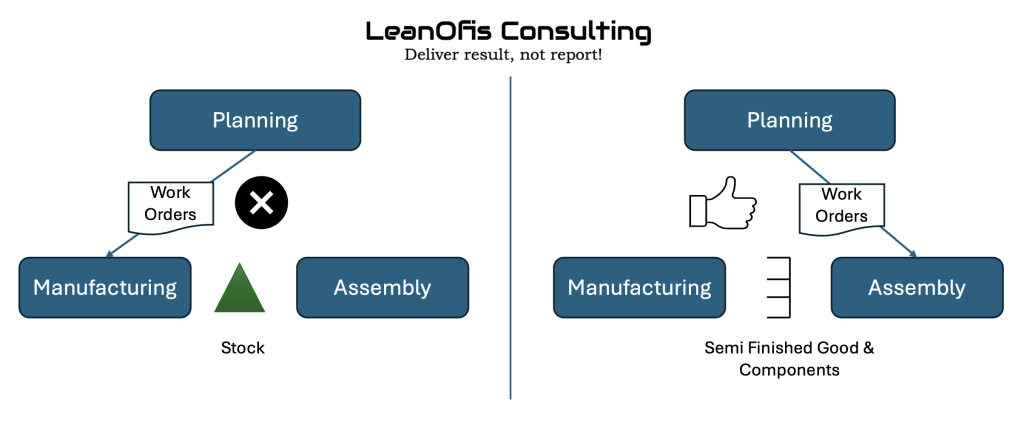
The assembly process is the revenue generator engine. Running this engine allows the company to make money by selling products assembled in the assembly process. Machining processes act like suppliers responsible for providing all necessary semi-finished goods for the products that will be sold to customers after being built on the assembly line. They support the assembly process in generating revenue as long as the assembly process consumes the parts to build the product the customer wants. Otherwise, machining processes can be considered waste generators. Thus, the key is to keep the assembly process running as long as there are customer orders, by running the machining process just enough to feed the assembly process without any delay. In normal situations, there should be a semi-finished product and component stock between manufacturing and assembly processes, and the assembly process consumes required materials from this semi-finished product and component warehouse. Therefore, if the warehouse is full of parts, there is no need to run the machining area to manufacture more parts than needed.
However, the planning process often starts with the machining area by trying to fill all the capacity of the machines. The aim is to utilize equipment and ensure that machine operators continue the manufacturing process without interruption. The main focus is on manufactured quantity and unit cost, and the chief of the manufacturing area is pushed to produce more parts to reduce unit cost. This often results in fewer changeovers and sometimes manufacturing more than needed, which is a key source of excess inventory, bad cash flow, customer unhappiness, and company inefficiency.
Thus, we do not need to use the full capacity of the machining process if we are not selling the manufactured products outside. We just need to plan for the assembly line and then make another plan for the machining area just for the missing parts in the semi-finished warehouse. In other words, the main function of machining is to fill the warehouse with needed parts before consumed by the assembly process. Stopping manufacturing as needed should not be seen as a problematic issue as long as the assembly process is running.
Think about it!