
In the context of manufacturing digital transformation (DT), it is essential to distinguish between two foundational stages: connectivity and intelligence. These dimensions are not interchangeable—rather, they represent a sequential and complementary progression along the transformation path.
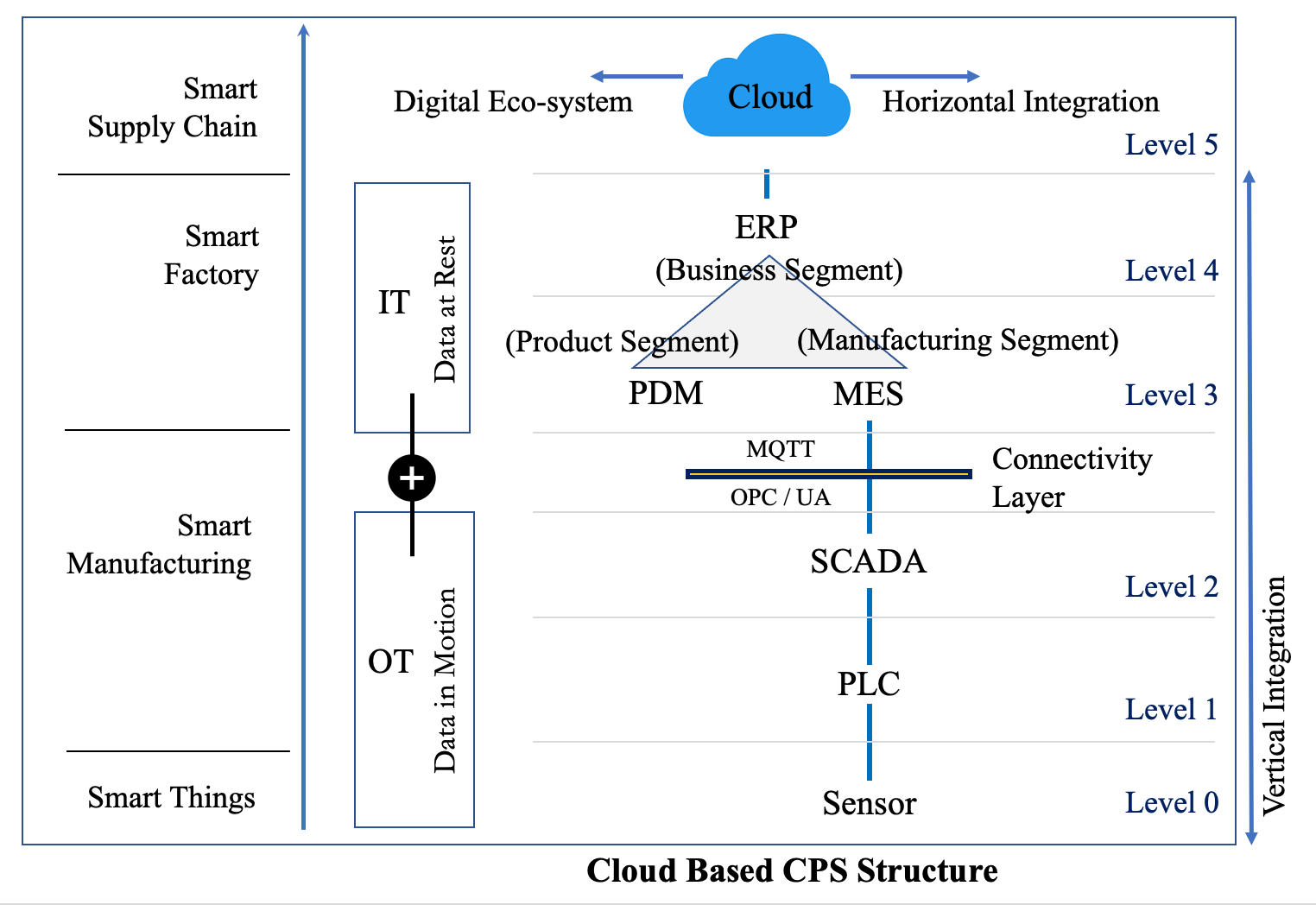
Connectivity refers to the technical capability of systems to exchange data in real time, forming the basis for interoperability. This is typically achieved through IT–OT convergence, where information technology (e.g., ERP, MES) is integrated with operational technology (e.g., PLCs, SCADA, sensors). Establishing such a backbone enables the real-time transmission of data across processes, assets, and decision-support platforms—creating a connected manufacturing ecosystem.
Once connectivity is in place, organizations gain visibility into shop shopfloor operations. Through dashboards and visual interfaces, companies can track work orders, monitor production, and identify bottlenecks. This stage enables data-driven continuous improvement (CI) but remains rooted in Industry 3.0 principles, where automation and control are siloed and reactive.
However, connectivity alone does not constitute “smartness.” Many organizations mistakenly assume that once systems are connected, they are digitally transformed. In reality, smartness only begins after connectivity is fully established.
Smartness, or intelligence, refers to the ability to derive actionable insights from operational data. This requires applying statistical models, machine learning, and AI-based analytics to detect patterns, predict disruptions, and enable autonomous decisions. Intelligent operations shift the organization from reactive visibility to proactive optimization.
In this stage, AI applications begin to add measurable value in areas such as:
- Predictive maintenance: anticipating failures before they occur,
- Computer vision: automating quality inspections,
- Smart scheduling: optimizing resource allocation in real time,
- Adaptive automation: dynamically adjusting process parameters for performance and quality.
These capabilities are only viable when supported by a connected and structured Cyber-Physical System (CPS) that ensures high-quality, contextualized, and timely data.
In summary, connectivity enables data to flow—intelligence turns that data into value. Digital transformation must begin with becoming connected, but its true potential is realized only by becoming intelligent. Without this progression, organizations remain stalled at the automation level, unable to capitalize on the strategic advantages offered by AI and advanced analytics.
.