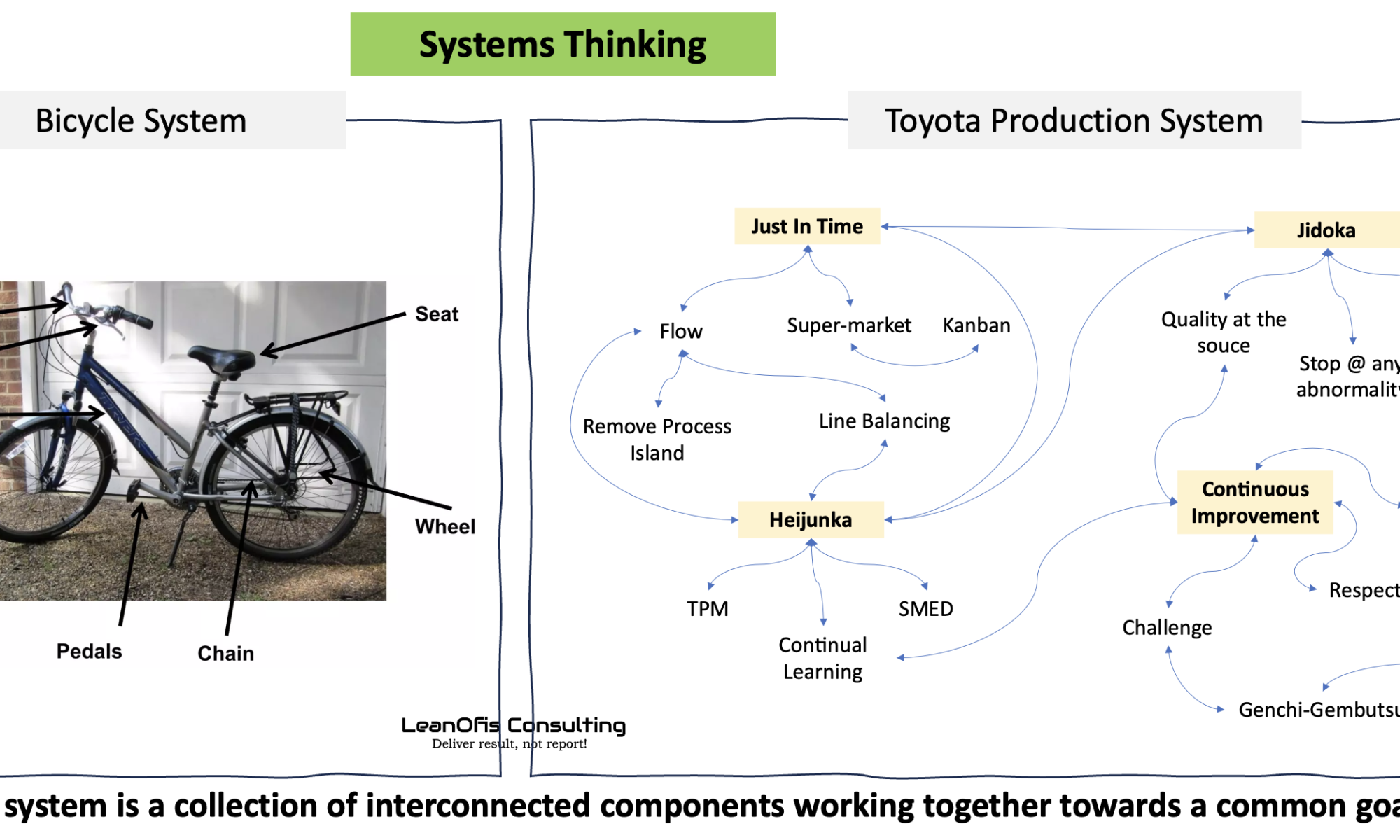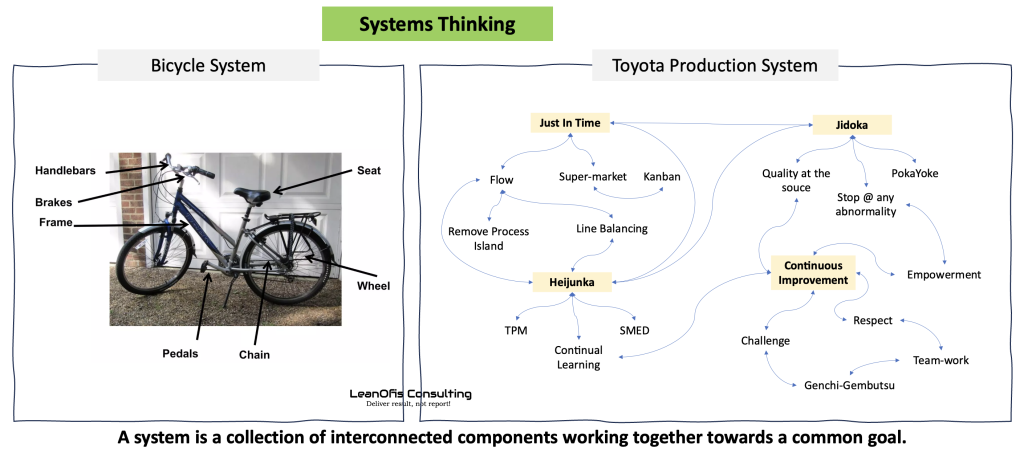
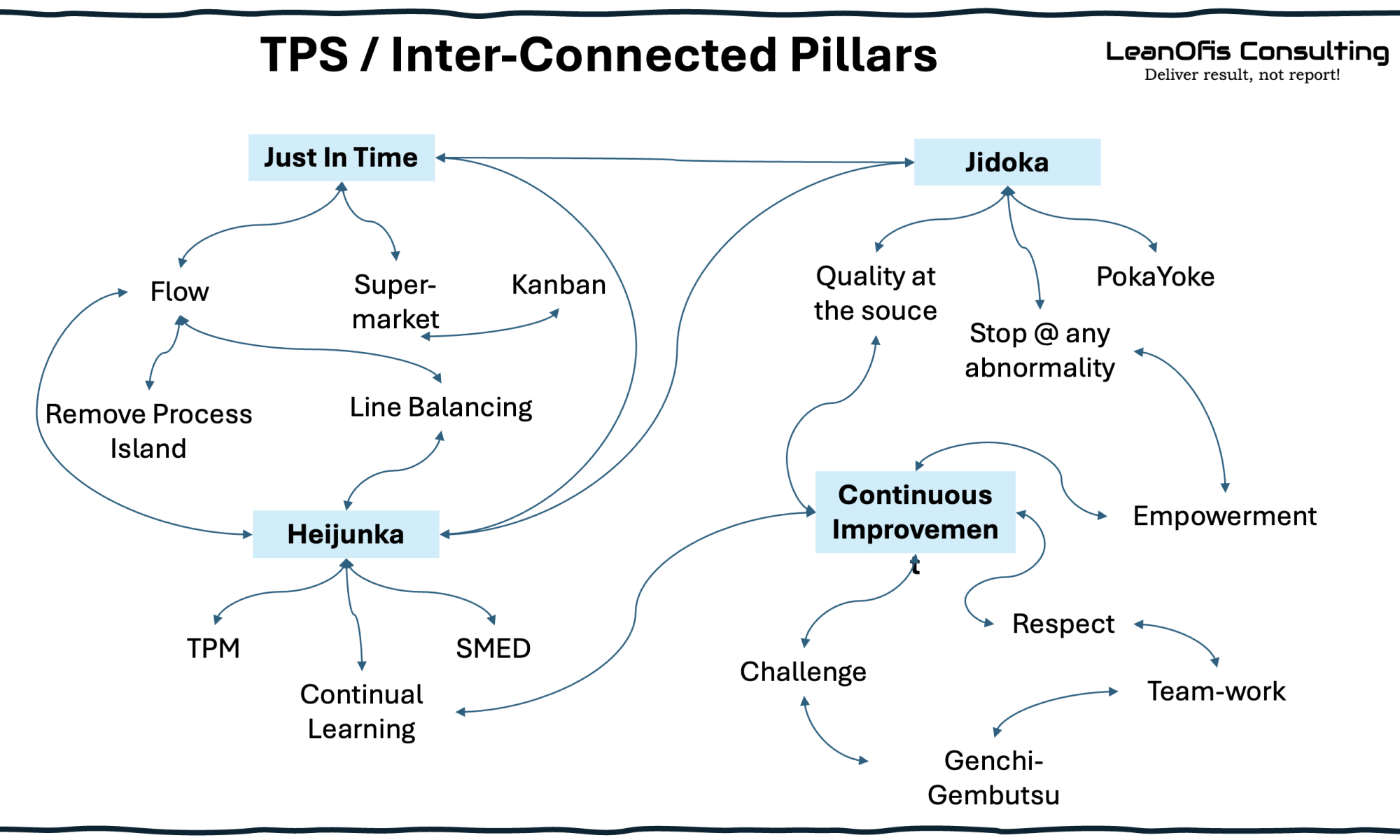
Toyota’s competitive strategy emphasizes productivity, quality, and variety through its Toyota Production System (TPS), which prioritizes achieving efficient flow and avoiding overproduction.. TPS includes:
- Just-In-Time (JIT): Balances and standardizes production, ensures smooth material flow, and reduces inventory and transportation losses using Kanban and supermarket systems.
- Jidoka: Embeds quality into the production process, empowers workers to address abnormalities, and uses poka-yoke to prevent errors.
- Heijunka: Levels production to minimize inventory, reduces equipment downtime through Total Productive Maintenance (TPM), and facilitates efficient product changeovers with Single-Minute Exchange of Die (SMED).
- Kaizen: Encourages continuous improvement and knowledge sharing across the organization through yokoten.
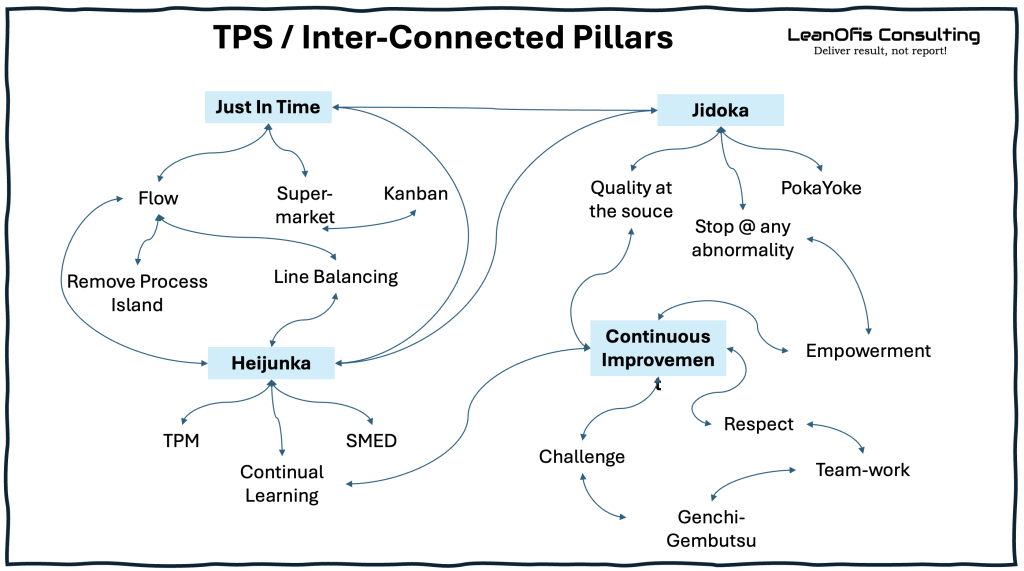
Each component within TPS plays a vital role, creating a synergistic system where interconnected elements work seamlessly to achieve desired outcomes. However, while TPS components significantly enhance manufacturing excellence, they often struggle to adapt to rapidly changing market conditions independently. To address this challenge, the integration of flexible methodologies like Agile Supply Chain Management (Agile SCM) is necessary.
Agile SCM provides the agility needed to respond swiftly to market fluctuations, enhancing the supply chain’s resilience and adaptability in today’s competitive environment, where the focus is on supply chains as a whole rather than individual companies. Thus, successful TPS implementation requires both internal coherence among its components and external alignment with Agile principles.
Systems Thinking is crucial for transformation as it views organizations and processes as interconnected systems rather than isolated components. This approach focuses on understanding the relationships and interactions between different parts of the system, addressing issues comprehensively. By analyzing how elements influence each other and the system as a whole, Systems Thinking enhances decision-making and problem-solving in complex environments.
In summary, for successful transformation, particularly in manufacturing and supply chain management, integrating various methodologies and adapting to dynamic conditions is essential. Systems Thinking provides a framework for managing these complex interactions, ensuring a more effective and cohesive approach to transformation.
Think about it!